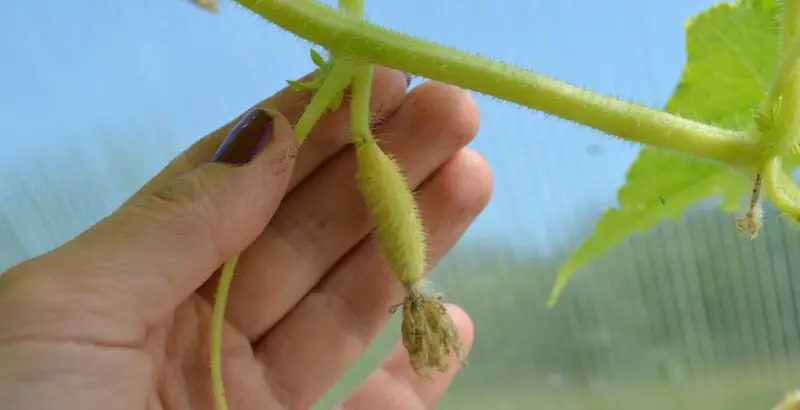
Cucumber ovaries often turn yellow and fall off, particularly in greenhouse settings. This problem usually arises from not following essential agricultural practices and care guidelines. Here’s why this happens and how you can prevent it.
Common Causes of Yellowing Cucumber Ovaries
1. Insufficient Lighting
Cucumbers need ample light to thrive. When grown in greenhouses, nearby plants can shade cucumbers, limiting their light exposure. To prevent this:
- Plant spacing: Arrange parthenocarpic hybrids at 1-2 plants per square meter and bee-pollinated varieties at 2-3 plants per square meter.
- Pruning: Pinch off the tops of shoots to a length of 20-25 cm, and remove excess tendrils, flower buds, and side shoots. This helps the plant focus energy on growth rather than unnecessary shoots and flowers.
2. Incorrect Temperature Conditions
Cucumbers are sensitive to temperature. Here are the ideal temperature ranges:
- Pre-fruit development in clear weather: 22-24°C
- Pre-fruit development in cloudy weather: 20-22°C
- Pre-fruit development at night: 17-18°C
- Ovary formation in clear weather: 23-26°C
- Ovary formation in cloudy weather: 21-23°C
- Ovary formation at night: 18-20°C
If temperatures exceed 25-27°C or drop below 13-15°C, cucumber ovaries can turn yellow and fall off.
To manage temperature:
- Increase temperature: Use extra film covers at night, insulate greenhouse walls with foam, create arc structures with flexible rods and cover them with perforated film, or use heaters.
- Decrease temperature: Ensure proper ventilation, water cucumbers in the morning, and spray the greenhouse film with a mixture of clay, chalk, or flour to reflect sunlight (avoid lime or permanent paint).
3. Lack of Trace Elements
Yellowing and dropping ovaries can result from nutrient imbalances:
- Soil enrichment: Avoid over-fertilizing or using manure. Use a solution of 1 tablespoon urea and 3 tablespoons wood ash dissolved in 10 liters of water for plant feeding. Alternatively, use a ready-made fertilizer.
- Wood ash: Apply 300 grams per square meter to enrich the soil.
4. Excessive Fruit Set
Hybrids with high fruit production can deplete nutrients quickly:
- Thinning: Regularly remove excess ovaries to prevent overburdening the plant.
5. Watering Issues
Watering is crucial for cucumber health:
- Pre-ovary: Water moderately.
- Post-ovary: Increase watering. Ensure the soil is moist but not waterlogged. Avoid cold water, which can cause premature ovary drop. Water with warm, settled water and adjust frequency based on weather and plant growth.
6. Bacterial Infection
Yellowing ovaries might indicate bacteriosis, which thrives in high humidity and poor soil conditions:
- Symptoms: Look for angular spots on leaves that turn brown, dry, and form holes.
- Treatment: Use a 1% Bordeaux mixture or 0.4% copper chloride suspension. For severe cases, treat with Gamayrom, Trichoderma Verideu, or Farmaiodom-3. In the fall, fumigate the greenhouse with Fas or Klimat sulfur checkers. For root neck necrosis, use Fitolavin 0.2% solution.
7. Lack of Bee Pollination
Some cucumber varieties require bee pollination:
- In greenhouses: Bees may not be present, and pollen can become sterile in heat.
- Manual pollination: Use a male flower to touch the stigma of female flowers.
- Attracting bees: Open greenhouse windows and doors frequently, and spray cucumber plants with a sweet water solution.
By addressing these factors, you can reduce the occurrence of yellowing and falling cucumber ovaries, leading to a healthier and more productive crop.